




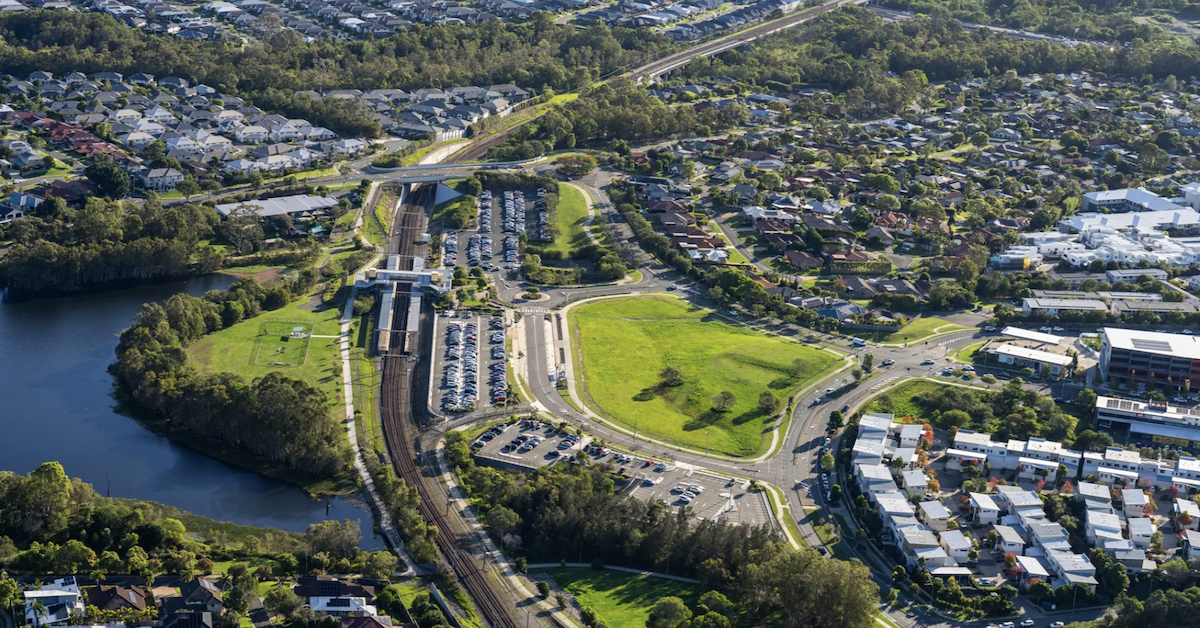
State-owned land directly opposite Mango Hill train station is being unlocked for new housing as part of a wider wave of medium-density development across Mango Hill, Rothwell and Deception Bay. The projects are increasingly targeting established areas where transport, roads and other infrastructure are already in place.
At the centre of the push is the Mango Hill site, being unlocked through the Queensland Government’s Land Activation Program and managed by Economic Development Queensland (EDQ). The land has been identified for up to 117 new residences, subject to formal planning assessments, combining proposed market-rate townhomes with affordable community housing.
Mango Hill Hub Anchors Transit-Oriented Medium Density
The Mango Hill development represents an intentional move to construct housing directly adjacent to existing transport and social infrastructure. Private developer Azure Group is proposing to deliver up to 68 one, two, three, and four-bedroom townhomes on the site, alongside communal amenities including a pool and recreation spaces.
The project sits alongside a complementary 56-apartment build by community housing provider Coast2Bay, which will introduce dedicated affordable rental options to the immediate precinct.
According to Azure Group Founder Chris Schroor, the site’s primary advantage lies in its immediate connectivity to established community assets.
“This Mango Hill site has fantastic amenity being across the road from the train station, within walking distance to shops and within a strong school catchment with multiple public and private options,” Schroor said.
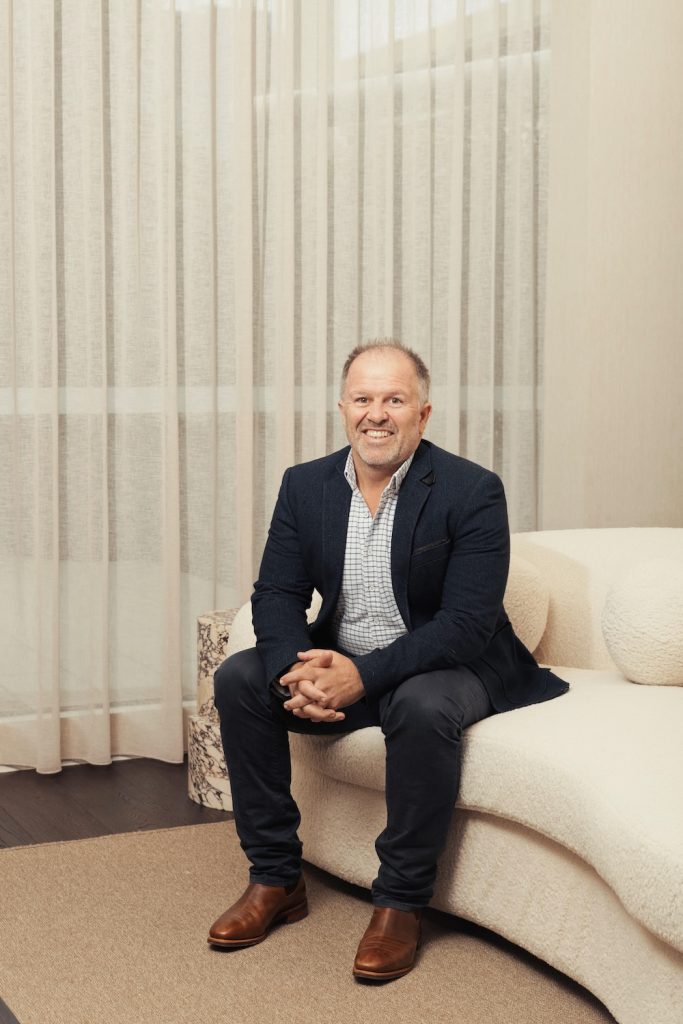
Photo Credit: Supplied
Unlike greenfield expansions on the suburban fringe, infill sites operating within existing Economic Development Queensland frameworks bypass many of the capital-intensive infrastructure delays that frequently stall new residential construction.
“Located within an existing community means that roads and trunk services are already installed and the site is therefore ‘plug and play’,” Schroor noted. “The land can be unlocked relatively quickly and free from the burden of trunk costs. This is the third site that we have acquired from Economic Development Queensland (EDQ) and as EDQ is also the planning authority the approval process is streamlined and we are able to start construction sooner.”
Azure Group anticipates progressing through the statutory approval process ahead of targeted construction in the second half of 2027.
Rothwell and Deception Bay Corridors Expand Townhome Footprint
The Mango Hill release is not an isolated initiative, but part of a broader build-out of medium-density stock stretching across the northern train line and coastal pockets.
With greenfield land availability tightening across North Lakes and surrounding estates, developers are increasingly scaling up townhome footprints in adjacent suburbs:
- Rothwell: Construction is actively progressing on Azure’s ‘Wellbrook’ project, a 240-townhouse master-planned community.
- Deception Bay: Planning is underway for a further 110 townhomes scheduled to break ground in upcoming stages.
- Established Track Record: The current pipeline follows completed infill projects including Elwood at Mango Hill, Willow at North Lakes, and The Terraces at Capestone.
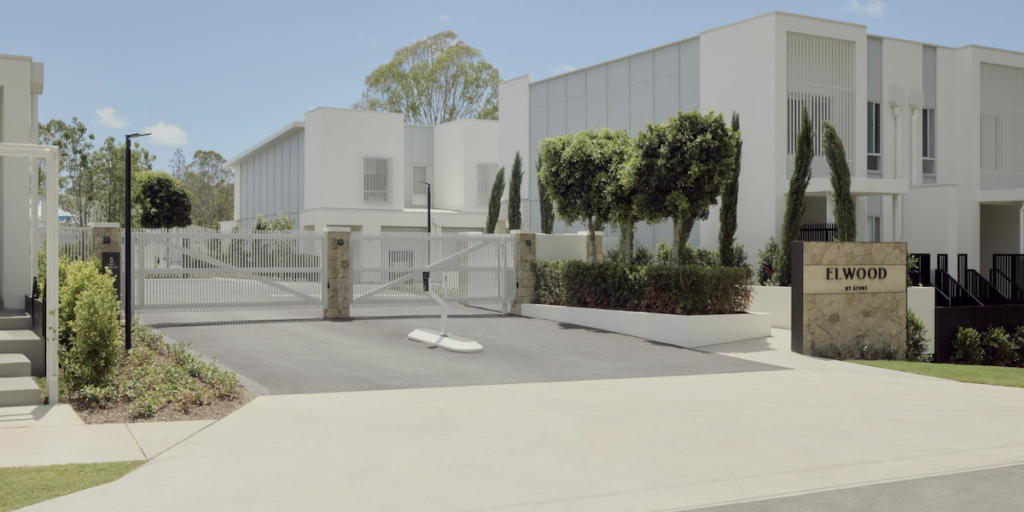
The ongoing concentration of activity across these specific suburbs reflects persistent regional migration and shifting buyer demographics seeking entry-level price points near major arterial connections.
Smaller Footprints Address Entry-Level Market Realities
As median house values across Greater Brisbane continue to rise, northern Moreton Bay has become a primary target for first-home buyers, young families, and property investors priced out of inner-ring suburbs.
“Affordability is a key driver for demand across Brisbane and as prices continue to rise it pushes purchasers further and further out from the Brisbane CBD,” Schroor said.
“In most instances this is pushing buyers into outlying new estates with limited amenity. However, our experience in the Moreton Bay region is that land is still available in good locations with good amenity, and at a price point that can still support a reasonable house price.”
To adapt to changing economic conditions, recent project designs reflect a shift in floorplan mix. Earlier townhouse developments in the corridor predominantly catered to three and four-bedroom family requirements.
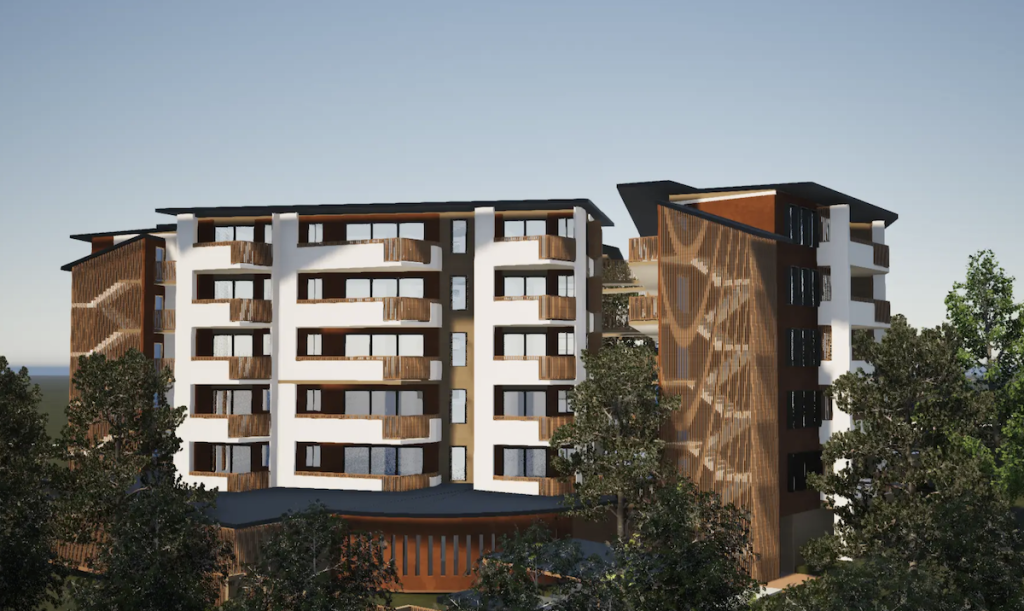
Photo Credit: Coast2Bay Housing Group/edq.qld.gov
Recent market responses, however, have prompted the introduction of compact one and two-bedroom layouts to lower the baseline purchase threshold.
“We have also identified a need for a lower price point product and smaller product and hence we have recently introduced a new one and two-bedroom design that we are looking to include in Mango Hill,” Schroor explained. “This adds to the diversity of product mix and significantly lowers the entry price for a purchaser.”
Infrastructure Bottlenecks Frame Long-Term Supply Realities
While infill initiatives like the Land Activation Program provide immediate relief by utilising urban land that has previously sat idle, long-term housing delivery across Moreton Bay faces structural hurdles.
Unlocking outer growth zones over the next decade will require substantial state and local capital investment to extend bulk water, sewerage, and road networks before major private sector projects can proceed.
“The challenge will be finding suitable land. The region will need to unlock further supply and work with developers, Queensland Government and supply authorities to bring in trunk infrastructure to the newer growth areas so that projects can commence ahead of time,” Schroor said.
While single projects yielding under a hundred dwellings do not solve regional supply deficits on their own, urban planners and industry leaders stress that steady, small-scale infill remains a vital component of urban consolidation.
“Rome wasn’t built in a day and detractors may argue that 68 dwellings is a drop in the ocean. However, our view is that activity builds activity and continuously unlocking land for development, big or small, is an integral part of the overall supply solution,” Schroor added.
“Moreton Bay has land supply. However, in many instances, the supply is in areas that need to wait for services to be connected… programs like the Land Activation Program can bring on supply to fill the void and supply new homes now.”
Published 20-Aug-2026


