



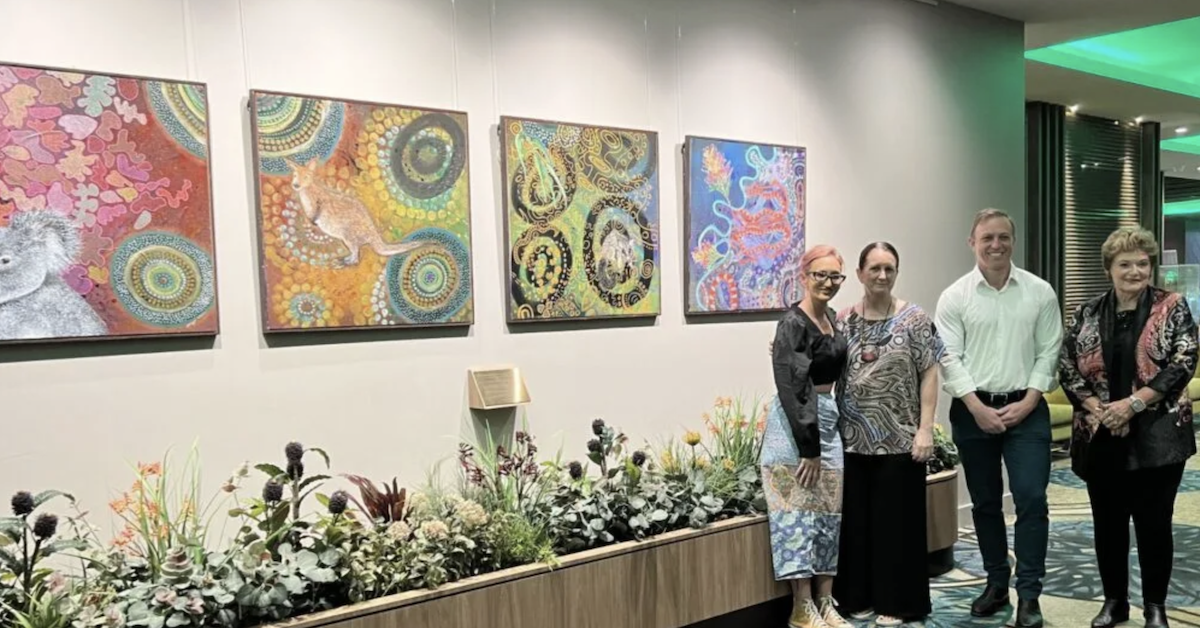
A brushtail possum travelling across Country, a Rainbow Serpent winding through the landscape and the footprints of kangaroos and emus all have a place in The Dreams of Gurwinda. But among the stories painted by First Nations artist Bianca Clark at Norths Leagues & Services Club in Kallangur is one that carries a particularly personal meaning.
It honours Aboriginal military service, including the contribution of Clark’s uncle Ned, who served in the Vietnam War.
That family connection helped shape an artwork bringing together ancestral stories, traditional knowledge and remembrance. Known by her Aboriginal name Wongai Wuru, Clark worked with the club and Gubbi Gubbi community representatives for approximately ten months to create the installation, which now forms a permanent part of the Kallangur venue.
A Family Connection Within Four Stories
In an interview with North Lakes Guide earlier this year, Clark spoke about the importance of acknowledging both her Aboriginal heritage and the First Nations people who served in Australia’s wars, particularly her uncle Ned.
His service provided a personal connection to the final section of the artwork, where kangaroo and emu footprints lead towards a scene of remembrance. The tribute sits alongside three other interconnected stories exploring ancestral journeys, the land and its resources, and community gatherings.
Native plants, traditional fishing equipment, a timber canoe and imagery associated with the Bunya nut harvest help tell those stories. Clark explained in the interview that she wanted the four sections to retain their individual character while working together as one composition.
The project also involved guidance from Gubbi Gubbi Elders, whose knowledge helped inform the cultural themes. At the official unveiling on 22 May 2026, Elder Aunty Christine spoke about her people’s longstanding relationship with Country and their responsibility to care for the land and wildlife.
READ: Historic Kallangur Church to Stay as New Special School Moves Ahead
When Digital Art Becomes Painting
The Dreams of Gurwinda, translated by the club as The Dreams of Many, exists in two forms: a large digital installation on the building’s exterior and four painted canvases displayed inside.
The digital artwork was installed in February, before the canvases were formally unveiled in May. Although both share the same themes, Clark described the experience of painting as distinctly different from creating the work digitally.
In her North Lakes Guide interview, she spoke about the physical experience of working with brushes and paint, and how the canvases developed their own character during that process. Her approach also involved considering how the Gubbi Gubbi ancestors might have understood the Kallangur landscape.
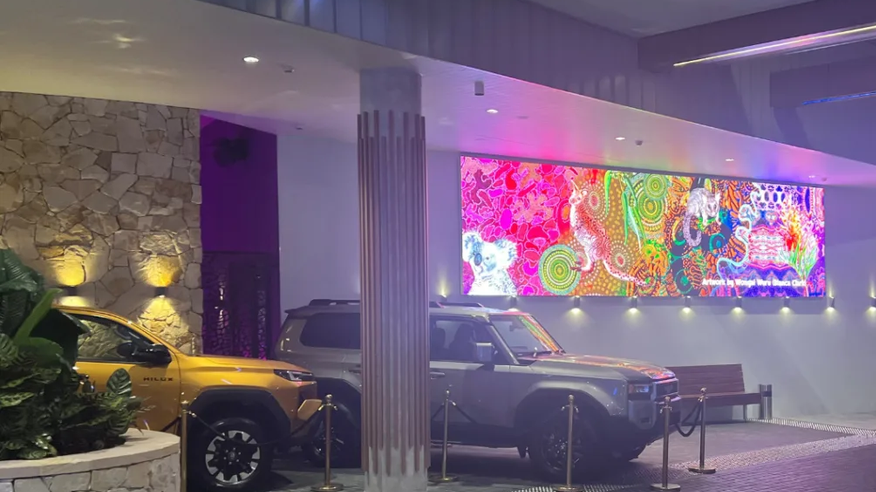

The resulting imagery draws together wildlife, plants, gathering places and cultural practices, rather than treating each as an isolated decorative element. Clark has explained that Wongai Wuru means snake girl in Gubbi Gubbi language, a name she uses in her creative practice.
Cultural Storytelling Beyond Kallangur
Clark’s artwork also appears in an educational resource published by the Gubbi Gubbi Dyungungoo Group. The organisation credits Wongai Wuru with creating the artwork for We Are Learning on Gubbi Gubbi Country, a poster made available for display in schools, early learning centres and community organisations.
The resource offers another setting for her artistic work, connecting visual storytelling with opportunities for children and other community members to engage with Gubbi Gubbi language and Country.
Unlike the large-scale installation at Norths Leagues, the educational poster is designed for everyday learning environments. Both demonstrate how her artwork can be encountered outside a conventional gallery.
READ: Kallangur Bowls Club Marks 60 Years With Plans for a Major Makeover
For visitors to Norths Leagues, the paintings offer more than a visual account of the area’s cultural heritage. They also preserve something of Clark’s own family history, particularly the memory of an uncle whose military service she wanted acknowledged. Months after the unveiling, that personal tribute remains part of a larger story about Gubbi Gubbi Country, its people and the connections carried across generations.
Published 9-November-2026


CLICK ANY LOGO TO SEE PUBLICATION