





By Jack Mercer – Rabbit Hole Fisherman
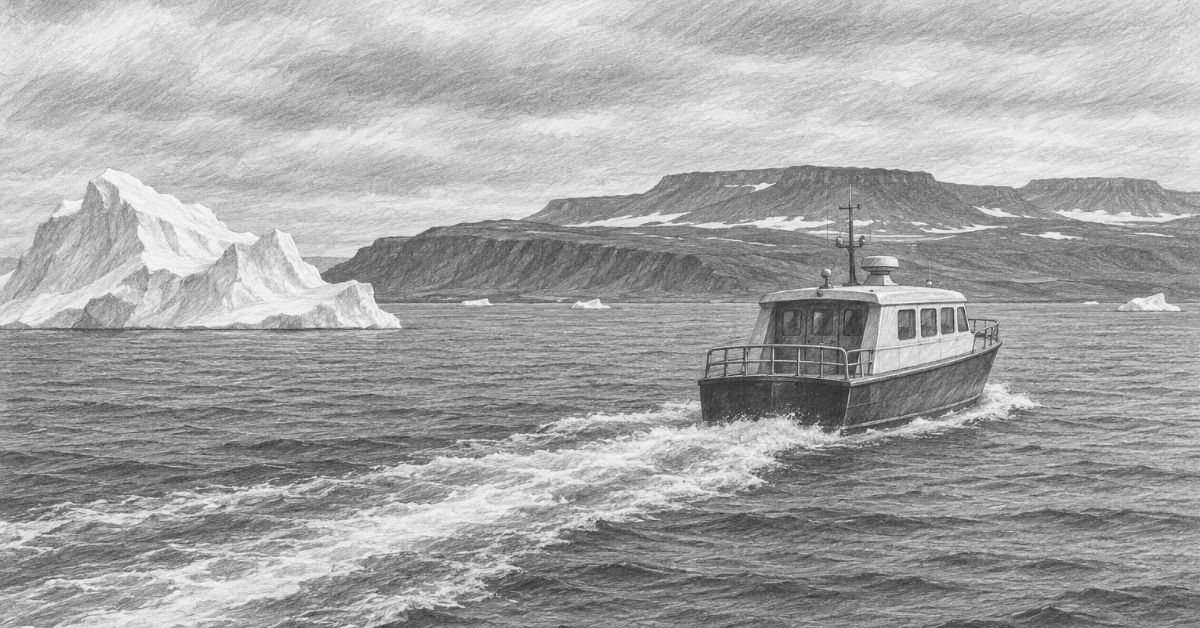
The Disko Bay ferry connects Ilulissat with Qeqertarsuaq, the principal settlement on Disko Island in West Greenland. In May 2012, travel writer Mark Stratton made the crossing and described his experience in Wanderlust. He spent much of the journey on deck, watching the crew steer around large icebergs before the cold drove him inside. It was the vessel’s first ferry trip to the island that summer. Snow still lay deep around Qeqertarsuaq when he arrived.
In This Story
- Following the ice through Disko Bay
- A working waterway, not just a visitor route
- Exploring Disko Island on foot
The crossing links Ilulissat, on Greenland’s west coast, with a community that has no road connection to the mainland. Passenger boats provide an important transport link, alongside the aircraft and helicopter services used elsewhere around Disko Bay.
Disko Line lists direct services between Ilulissat and Qeqertarsuaq, although visitors should check the operator’s current timetable rather than assume a particular departure is available. Boat transfers are generally associated with the summer travel season, while helicopter connections provide another option.
For passengers, the journey offers views of the icebergs that dominate this part of Greenland. For residents, it is also a practical connection between communities. Weather and ice conditions can affect travel.
Following the ice through Disko Bay
Before leaving Ilulissat, visitors can explore the coastal viewpoints overlooking the Ilulissat Icefjord. The fjord is the seaward outlet of Sermeq Kujalleq, a glacier that carries ice from the Greenland ice sheet towards the coast. Large sections break away through a process known as calving, sending icebergs into the fjord. UNESCO inscribed the Ilulissat Icefjord on its World Heritage List in 2004.
The ice does not necessarily move straight into open water. At the fjord’s mouth, a shallow underwater feature called Isfjeldsbanken, or the iceberg bank, catches many of the larger bergs. They can remain grounded there until melting or pressure allows them to move into deeper water.
Icebergs and sea ice are different. Icebergs originate on land, breaking away from glaciers or ice shelves. Sea ice forms when ocean water freezes. Disko Bay can contain substantial amounts of glacial ice without being covered by continuous sea ice.
From a passenger vessel, the visible portion of an iceberg gives little indication of its full size. Much of its mass remains underwater, and its shape changes as it melts and breaks apart. Stratton’s account describes the crew navigating around the larger bergs during his crossing. Passengers should leave navigation to the vessel’s crew and follow their instructions.
A working waterway, not just a visitor route
The Disko Bay ferry is part of a wider maritime transport network. Passenger services extend beyond the Ilulissat–Qeqertarsuaq crossing, with connections to Aasiaat and other communities around the bay. Boats, aircraft and helicopters link settlements that cannot be reached by road.
Freight operations are separate. In a 2024 profile for the Danish Seamen’s Mission, Hanne Baltzer interviewed Jørgen Kjær Jensen, master of Royal Arctic Line‘s settlement ship M/S Pajuttaat.
Jensen described delivering supplies to communities around Disko Bay and Uummannaq Bay. His vessel carries a crane and barge, allowing the crew to unload cargo where conventional harbour facilities are limited. Weather and ice conditions influence when particular settlements can be reached.
He also recalled a season when the usual sea ice had failed to arrive in part of the ship’s operating area. The crew used the opportunity to make an additional trip, collecting frozen fish from settlements and freeing storage space for local fishermen.
The account illustrates the importance of maritime transport to communities across the region. These are inhabited places with working harbours, local industries and transport needs, not simply stops on an adventure itinerary.
Exploring Disko Island on foot
Stratton’s account also records an older way of crossing the bay. His guide, Kale Mølgaard, recalled travelling by dogsled over sea ice towards Ilulissat. During Stratton’s 2012 visit, the two travelled by snowmobile towards the island’s glacier. These are historical experiences from the published account, not recommendations for independent travel across sea ice.
Qeqertarsuaq has a distinctive landscape shaped by volcanic activity. Its surroundings include basalt mountains, black sand beaches and extensive vegetation. The University of Copenhagen’s Arctic Station, located outside town, provides a base for scientific research into the island’s environment.
One of the area’s recognised walking destinations is Kuannit, known for its columnar basalt formations and vegetation. Visit Greenland describes the excursion as a half-day, moderate hike. Tracks around Qeqertarsuaq can be uneven and poorly marked, so visitors should establish current route conditions locally and consider using an experienced guide.
The name Kuannit also has a connection to local life. It refers to angelica, a plant traditionally used by residents for food and drinks. The surrounding vegetation is part of the area’s ecological and cultural value, not merely scenery for visitors.
Qeqertarsuaq’s community guidelines ask visitors to use established paths, avoid picking plants, respect private property and seek permission before photographing local people. AECO also reminds visitors that Greenlandic sled dogs are working animals, not pets, and should not be approached or fed without their owner’s permission.
Weather can change quickly, and Greenland’s remote terrain means assistance may take time to arrive. Visitors heading beyond town should follow local advice, carry suitable equipment and avoid treating a familiar-looking route as automatically safe.
The crossing introduces visitors to Disko Bay, but time spent in Qeqertarsuaq reveals another side of the journey. The island is not simply a backdrop of ice and volcanic rock. It is a community whose connections with the mainland, surrounding waters and landscape continue to shape everyday life.
Editor’s source note: This feature draws on published accounts and institutional sources. No original interviews were conducted. Mark Stratton’s journey and Kale Mølgaard’s recollections relate to 2012. Jørgen Kjær Jensen’s freight account relates to a separate Royal Arctic Line vessel and operation. Current ferry departures and local access conditions should be checked before travel.