




By Jack Mercer – Rabbit Hole Fisherman
Japan’s Kumano Kodo links mountain shrines by forest paths and village roads. Walking the Nakahechi route means steep climbs, small inns and local guides who can point out what a visitor might otherwise miss.
In This Story
- The meaning of “ninety-nine”
- A route through living country
- Sacred places, shared paths
- Takijiri-oji to Takahara
- Why a guide helps
- The people in the story
- Lodging as part of the walk
- Dinner, breakfast and the next day
- Booking ahead matters
- Luggage, shuttles and shorter walks
- Hongu, flood and renewal
- Oyunohara and the present shrine
- Yunomine Onsen
- The long way to Nachi
- Wet stones and tired legs
- Arrival at Nachi
- Closing note
The meaning of “ninety-nine”
The ninety-nine shrines are not necessarily ninety-nine shrines.
Along Japan’s Kumano pilgrimage roads, the smaller oji shrines are collectively called the Kyujukyu Oji, the Ninety-nine Oji. The local tourism bureau says the number expresses abundance rather than an exact count. These shrines helped protect and guide pilgrims, offering places to worship and rest between the grand shrines ahead.
It is a useful reminder that this walk rewards more than counting kilometres. A modest roadside shrine can matter as much as a mountain view.
A route through living country
Kumano Kodo names a network of pilgrimage routes through the Kii Peninsula in southern Honshu. The popular Nakahechi route connects the Kumano grand shrines and can be walked in consecutive days or shorter sections. It has mountain villages, local buses and an established network of accommodation.
That makes it appealing to travellers whose Japan has mostly been train stations and cities. A day on foot ends somewhere people live, with time to learn a little about the place before moving on.
Sacred places, shared paths
There is more history here than any single itinerary can hold. The UNESCO World Heritage property, inscribed in 2004, brings together sacred sites at Kumano Sanzan, Koyasan and Yoshino and Omine, along with their connecting pilgrimage routes. UNESCO describes a tradition of sacred mountains stretching back more than 1,200 years.
A visitor does not need the religious knowledge of a pilgrim. Curiosity is enough, provided it comes with respect for people who are there to worship. These are active sacred places, shared with hikers whose immediate concerns may be sore feet and lunch.
Takijiri-oji to Takahara
For walkers starting at Takijiri-oji, the mountain section begins quickly. The route to Takahara is only about four kilometres, yet the Tanabe City Kumano Tourism Bureau allows two to three hours and lists about 430 metres of total ascent. It climbs through native and planted forest to a village overlooking the Hatenashi mountains. Takahara’s shrine stands among giant camphor trees.
Four kilometres can sound modest over breakfast. Here the elevation column deserves equal billing.
Why a guide helps
The forest also deserves proper attention. This is country with a long human history, including planted woodland, not a vast untouched forest conveniently fitted with an ancient trail. Villages and cultivated land are part of the experience. The appeal comes from travelling between them slowly enough to notice the transitions.
A local storyteller can make those transitions more meaningful. In a first-person account for Meguri Japan, writer Chiho Kuriyama walked from Hosshinmon-oji towards Kumano Hongu Taisha with guide Emiyō Katō, described as locally born and raised and part of the Kumano Hongu Storytellers’ Circle. [5]
The people in the story
Among the figures Katō brings into the journey is Fujiwara no Teika, the poet who accompanied retired emperor Go-Toba on pilgrimage. As Katō explained it, Teika went ahead to arrange meals and accommodation. His journal also recorded how difficult he found the journey.
That is a welcome detail among emperors and sacred destinations. Someone had to organise where everyone slept. Someone also complained about the walking. The past becomes easier to picture when its inhabitants have responsibilities and aching legs, instead of appearing only as names on a noticeboard.
Lodging as part of the walk
A map can show where a path goes. A knowledgeable companion can explain why a small place along it mattered to the people coming through. The bureau lists local guiding services and advises checking for national or regional guide qualifications.
Accommodation shapes the walk too. A minshuku is generally a small family-run guesthouse, often with Japanese-style rooms and shared bathing facilities. Ryokan inns vary more widely in size and style, with many offering tatami rooms and futons, and some providing beds. Meals and facilities differ between properties.
Dinner, breakfast and the next day
For walkers, those differences matter beyond the booking photographs. The room is where clothes get sorted for the next day and the route is reconsidered in light of how today actually went. Staying several nights in different small places also gives the journey a sequence of hosts, rather than a single resort staff.
Australian writer Benjamin Law’s Nakahechi account for Qantas Travel Insider includes a stay at Hatago-Masara, then run by a French-Japanese couple. He described meals that reflected that combination, including French beef stew at dinner and Japanese dishes at breakfast. Elsewhere along his walk, the hosts and styles of accommodation varied.
Booking ahead matters
The practical side has limits. The bureau warns against arriving in mountain settlements without accommodation booked: rooms are limited, and a property may be closed or have no food prepared if it has no reservations. Meals often begin around six in the evening.
Those arrangements deserve more thought than an optimistic estimate of walking speed. A host preparing dinner needs to know who is coming. Food preferences and dietary needs belong in that conversation before arrival, when there is time to establish what can be provided.
Luggage, shuttles and shorter walks
Luggage transfers can make the walk less burdensome. The bureau’s community booking system offers daily services between eligible accommodation, allowing walkers to carry only a day pack. It currently specifies booking at least twenty days ahead and ties online shuttle reservations to accommodation booked through KUMANO TRAVEL.
Near Hongu, the Hosshinmon-oji section offers a shorter way to experience the route. The official course is about 7.5 kilometres, usually allowing two to three hours. It passes through villages and forest, with tea plantations and terraced fields around Fushiogami. At Fushiogami-oji, pilgrims traditionally knelt after catching their first view of the grand shrine below.
Hongu, flood and renewal
Kuriyama and Katō’s account describes taking longer over their walk. That is hardly a failure of the official estimate. Stopping to listen is part of the reason to have a storyteller along. It also gives the shorter walk a different value from simply covering less ground than someone else.
The destination itself has changed in ways that are easy to miss when a place is introduced as ancient. Kumano Hongu Taisha once stood at Oyunohara, a sandbank near the meeting of two rivers. A severe flood in 1889 destroyed many buildings, and surviving structures were rebuilt at the present site.
Oyunohara and the present shrine
Oyunohara remains sacred. Its enormous torii gate, 33.9 metres high, was erected in 2000 and is made of steel.
The dates belong beside each other. A pilgrimage tradition can be old while the structures serving it are repaired, relocated or newly built. Looking for an entirely unchanged past would mean missing much of what kept this place in use.
At the present Hongu shrine, even the bark roofs need renewing. The bureau says Japanese cypress bark is replaced at intervals of forty to fifty years, work dependent on traditional materials and skilled craftspeople. Preserving the shrine means continuing to work on it.
Yunomine Onsen
The same is true of Yunomine Onsen. Pilgrims used its waters for purification before worship at Hongu. The village’s small Tsuboyu bath occupies a cabin beside the creek, and the hot spring connection continues in the shrine’s spring festival rites. There is also a public hot-water cooking basin where visitors can cook eggs.
Sacred bathing and a practical use for hot water occupy the same small village. A tired walker can appreciate the bath without claiming to have had a revelation. Knowing its older purpose adds something to the experience without dictating what anybody must feel.
The long way to Nachi
Reaching Hongu is enough for some itineraries. Those continuing towards Nachi have further mountain walking ahead, including the Kogumotori-goe and Ogumotori-goe sections through Koguchi. On the latter, heading from Koguchi towards Nachi, the route gains about 800 metres in its first five kilometres. The climb is known as Dogiri-zaka, translated by the bureau as the Body-breaking Slope.
There is little ambiguity in that name.
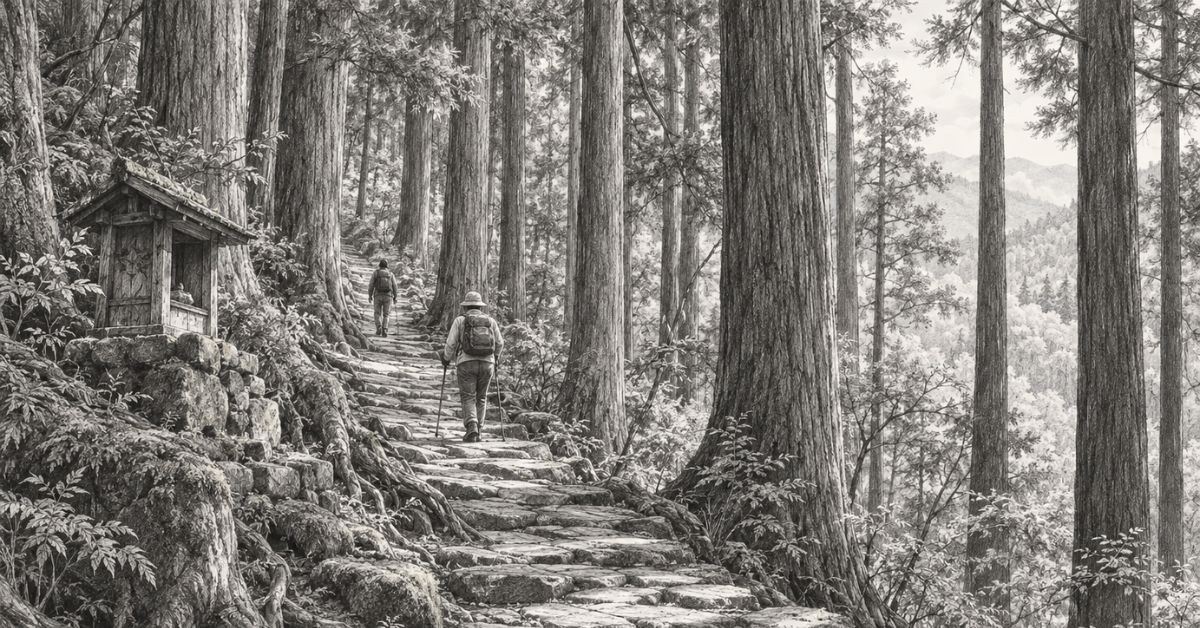
The whole Ogumotori-goe section is about fourteen kilometres, with roughly 1,260 metres of total ascent and an estimated seven to nine hours of walking. It crosses three passes, and there are no restaurants along the trail. Those figures are a better guide to the day than a photograph of an inviting stone path disappearing among cedars.
Wet stones and tired legs
Wet stones and roots need care. The bureau warns that old cobbled steps can become particularly slippery, and advises against walking during extreme weather. This is a supported walking destination, but still a mountain environment. Current conditions matter more than how easily a previous visitor completed it.
Law found the final day of his Nakahechi walk especially hard on the legs. His experience helps explain why the evening comforts belong in the story. They let travellers recover enough to enjoy the next day, and give people a reason to linger in the communities between the climbs.
Arrival at Nachi
At Nachi, the landscape itself helps explain the pilgrimage. Kumano Nachi Taisha’s religious origins lie in worship of the waterfall, Nachi-no-Otaki, which drops 133 metres from the forest above. Nearby Seiganto-ji is a Buddhist temple closely associated with the Shinto shrine. The relationship between belief and the natural world becomes visible in a specific place, rather than staying as a paragraph of history.
For the visitor, arrival can be ordinary as well as moving. There are arrangements for getting to the next town and the question of where to sleep. Nobody is obliged to produce a profound verdict on the walk before attending to either.
Closing note
Teika had meals and lodgings to organise centuries ago. Today’s walker has much more help available, and can spend longer over the shrines and the stories. On the steep sections, though, the old complaints still make sense.